From the Blue Community ECC – Church of Christ in Congo DR:
Generating Health in the DRC: Can we think about Health without thinking about Peace?
By Dr. Nathan Bundutidi Makaya*
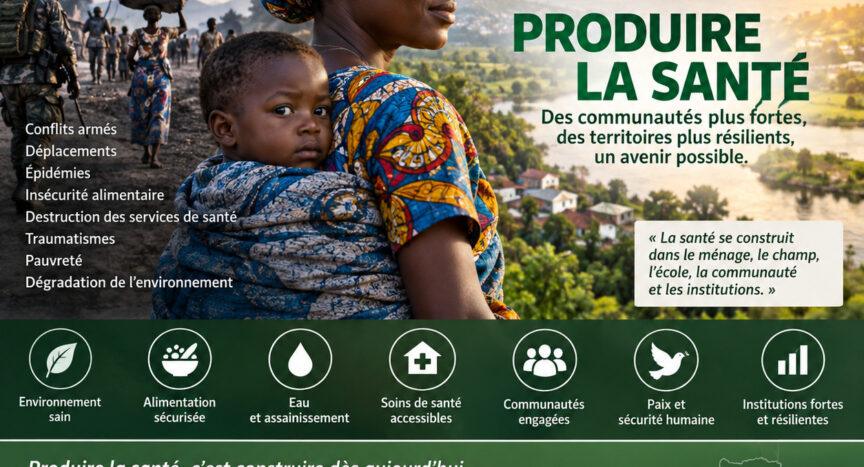
For several months, I have been developing a line of thought regarding the territorial production of health: how can we move beyond a primarily disease-centered approach to understand the conditions that enable a population and a territory to preserve their health and adaptive capacity?
This question takes on a particular dimension in the Democratic Republic of the Congo.
For decades, certain regions of the country have experienced overlapping crises: armed conflict, population displacement, epidemics, food insecurity, fragile WASH infrastructure, and disrupted health services.
These phenomena are interconnected.
Conflict causes more than just death, injury, and displacement. It can disrupt agriculture and markets, exacerbate food insecurity, interrupt medical care and vaccination programs, weaken epidemiological surveillance, and compromise access to water, hygiene, and sanitation.
In doing so, it diminishes individual, community, and institutional capacities to cope with crises.
Conflict and insecurity → territorial disruption → weakening of food, health, economic, and WASH systems → increased vulnerabilities → reduced adaptive capacity → diminished territorial resilience.
Successive Ebola epidemics in the DRC—starting with Yambuku in 1976—demonstrate how a biomedical response relies on functional territorial systems: surveillance, laboratories, primary care, protected personnel, community engagement, WASH, logistics, and institutions capable of coordinating action.
This leads us to a fundamental proposition:
Peace and human security are also fundamental determinants of health.
At CEMPIK, we therefore propose studying the territorial production of health as a territory’s capacity to organize, protect, and renew the biological, nutritional, environmental, health-related, social, and institutional resources necessary for health. This concept could be operationalized through a future Territorial Health Production Index (ITPS), designed not to rank territories, but to identify their capacities and vulnerabilities prior to crises.
Producing health does not mean promising an absence of disease. It means creating the conditions that enable individuals, communities, and territories to better withstand, adapt to, and recover from challenges.
In the DRC, this also entails considering peace, human security, and territorial resilience.
*Dr. Nathan BUNDUTIDI MAKAYA
ECC provincial coordinator for medical services and coordinator for the ECC “Blue Community” initiative.
Assistant at the Kongo University Faculty of Medicine, Research Assistant and Head of the Kisantu branch at the Institute for Health Sciences Research (IRSS)
Founder of the Center of Excellence in Preventive and Integrative Medicine, an interdisciplinary center for research, training, and innovation officially affiliated with Kongo University.
General Practitioner & Researcher in Preventive and Integrative Medicine
#HealthProduction #OneHealth #DRC #PublicHealth #HumanSecurity #Resilience #CEMPIK