
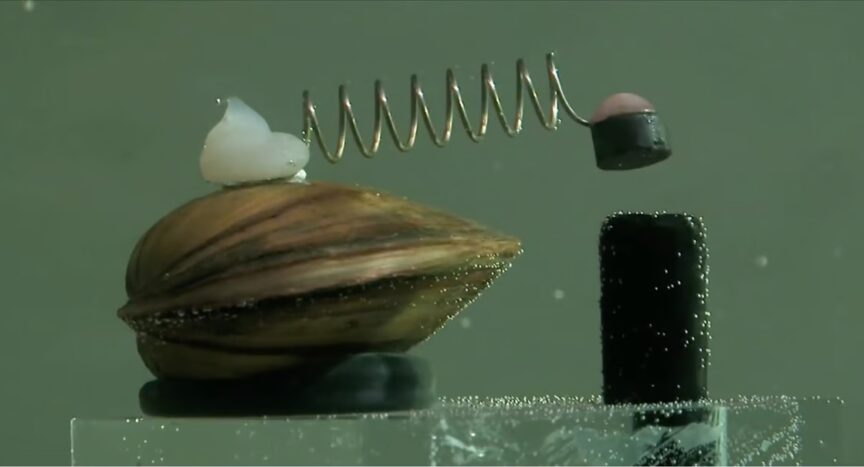
In the city of Poznań, Poland, a group of eight clams controls the local water supply through a clever bio-monitoring system:
These biological systems are comprised of eight mussels with sensors hot-glued to their shells. They work together with a network of computers and have been given control over the city’s water supply. If the waters are clean, these mussels stay open and happy. But when water quality drops too low, they close off and shut the water supply of millions of people with them.
According to The Economist (archive), more than 50 such systems are now deployed in Poland and Russia to help protect water supplies:
The system is nifty. When the molluscs encounter heavy metals, pesticides or other pollutants, they close their shells, explains Piotr Domek of Adam Mickiewicz University in Poznan, who has worked on the project for three decades. To create a natural early-warning system, Mr Domek and his colleagues collect the clams from rivers or reservoirs, and attach a coil and a magnet to their shells. Computers register whether their shells are open or closed by detecting changes in the magnetic field.
“In the case of a terrorist attack, an ecological disaster or another contamination of the water supply, the clams will close.”
This, in turn, will automatically cut off the water supply. The clams, he thinks, are life-savers. He says in “Fat Kathy”, a short film that celebrates the invaluable bivalves:
“If contaminated water goes straight to our taps, we will get poisoned.”
Each worker mussel spends three months on duty — after that, they become too accustomed to their new surroundings and are no longer sensitive enough to properly monitor the water. For retirement, they are gently tossed back where they came from.
You can watch that short film here:


