
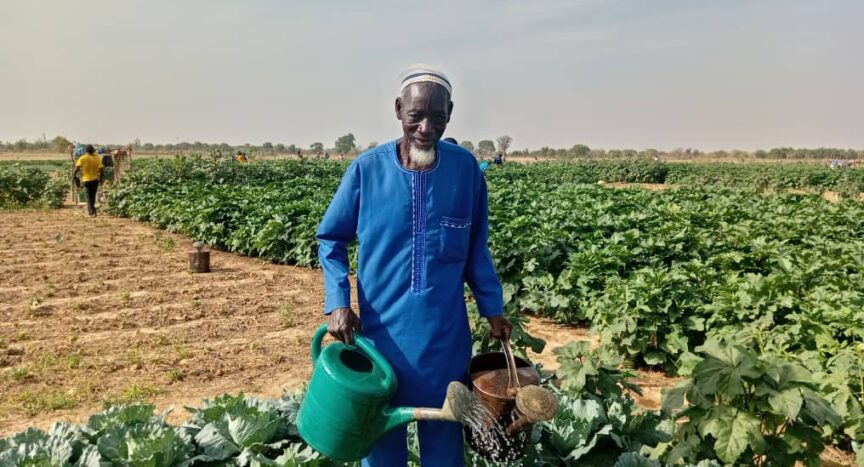
Boureima Sawadogo: “I can produce without fear” thanks to rainwater collection tanks in Burkina Faso.
In Burkina Faso, erratic rainfall is causing major crop losses. Figures from the Ministry of Agriculture show that the 2011-2012 agricultural season was marked by a drop in cereal production of around 19.61% compared to the previous season due to low rainfall. In response to these droughts, the Government of Burkina Faso, in collaboration with its local and international partners, proposed the introduction of runoff water collection basins (BCER) in 2012-2013 as a solution to enable smallholder farmers to save their crops during periods of drought.
After losing 15 hectares of maize in 2019, Boureima Sawadogo, a seed producer in the village of Poura in northern Burkina Faso, introduced BCERs in 2020. These rectangular structures, which are at least 13 metres long, 8 metres wide and 2 metres deep, can store up to 300 cubic metres of water, with the aim of conserving run-off water for use by the producer during periods of drought.
Beyond their importance for irrigation, BCERs provide other services to rural communities, as maize, millet and sorghum farmer Boureima Sawadogo told Mongabay in an exclusive interview.
Mongabay: You are a farmer in Poura, a village in the northern region of Burkina Faso. What rainfall constraints do you face?
Boureima Sawadogo: Pourra is a village where agriculture remains one of the main activities of the local population. This Sahelian zone is one of the most affected by water crises. Droughts are frequent and the lack of rain threatens crops. It is important to choose short-cycle seeds that can be harvested after 80 days.
Mongabay: Yield loss is a major concern for growers. How is the drought affecting your business?
Boureima Sawadogo: I’m a seed producer. In 2019, I produced five hectares of maize. But I lost everything because of the drought. I was supposed to harvest 15 tonnes of maize and sell it for 500,000 CFA francs (USD 833) per tonne. The drought had a serious impact on my productivity and I recorded a loss of 7,500,000 CFA francs ($12,500).
Mongabay: At that point, did you consider stopping everything, and how did you manage to recover and cope financially?
Boureima Sawadogo: The loss hit me hard. Losing 7,500,000 CFA francs (USD 12,500) is a huge loss for me. Maize doesn’t survive well without water, so I lost everything. Fortunately, I had also planted millet and sorghum, which are more resistant to drought. I used the money I earned from these crops, plus some savings, to start again the following year. Farming is my only job, I couldn’t give it up.
Mongabay: Have other farmers in your village experienced the same situation?
Boureima Sawadogo: Farming in Poura is uncertain because of the low rainfall. If you harvest this year, you’re not sure if you can harvest next year. The period from 15 July to 15 August is very difficult for us farmers. It can often be several weeks without rain and we’re already in production. It’s just the wind that blows. We usually use crescent and zaï techniques, but that’s not enough. Because of this, some households have even left the villa.
Mongabay: Have other farmers in your village experienced the same situation?
Boureima Sawadogo: Farming in Poura is uncertain because of the low rainfall. If you harvest this year, you’re not sure if you can harvest next year. The period from 15 July to 15 August is very difficult for us farmers. It can often be several weeks without rain and we’re already in production. It’s just the wind that blows. We usually use crescent and zaï techniques, but that’s not enough. Some households have even left the village for other parts of the country where the rainfall is more favourable for agriculture. BCERs are a good solution. They allow us to better deal with the lack of rain.
Mongabay: Can you tell us what a BCER is and how it works?
Boureima Sawadogo: I can say that the BCER is a big hole that we dig in the field to collect rainwater. When it stops raining, I use this water to irrigate the crops. It’s a great help in times of drought, so I don’t lose my crops. My BCER is 13 metres long, 8 metres wide and has a capacity of 300 cubic metres. I’ve installed a motorised pump to irrigate the field. But I also often use watering cans for gardening.
Mongabay: How did you come up with the idea of using BCERs to save your production in the event of a drought?
Boureima Sawadogo: In 2020, I heard about check dams (BCERs) and decided to use this technique on my farmland. A project in my village helped me to introduce BCERs. Since then, there’s been a change: I can produce without fear. Even if there isn’t enough rain, the stored water allows me to water my crops. I’m able to meet my forecasts for the season. The first year I installed BCER, I planted three hectares of maize to see if it would work. In fact, it helped me a lot when the rain stopped. It was good news for me because I’d lost everything the year before.
Mongabay: What is the total cost of investing in this solution?
Boureima Sawadogo: I invested almost 3 million CFA francs ($5,000) in setting up BCER. My farm is very stony and it was difficult to dig. So I spent a lot. But for producers whose land isn’t stony, the construction costs don’t reach mine.
Mongabay: What difficulties do smallholder farmers in the region face in adopting this solution?
Boureima Sawadogo: BCER saves us small farmers. When there’s an area of drought, many farmers are at great risk of losing their crops because the heat causes the leaves to wither quickly. This loss does not only affect farmers in the village of Poura, where I come from. Farmers in neighbouring areas face the same risks. If you don’t have a solution to save part of your production, you can’t harvest.
Mongabay: Since you started using this method, what impact have you seen on your production levels?
Boureima Sawadogo: This year, for example, when I used BCER, I didn’t lose any crops. I had a good harvest. At the beginning of August 2024, for example, it rained for almost two weeks. I irrigated my crops with stored water. But farmers who didn’t use this innovation had problems because the plants were weakened by the drought.
Mongabay: Other than irrigation, what else can BCERs be used for?
Boureima Sawadogo: I saw the results of this innovation. I said to myself, since there’s water, we need to find another activity. So I also started fish farming. In 2020, I released 2,250 fry. After that, I sold them for more than 800,000 CFA francs. In 2024, thanks to fish farming, I earned 1,250,000 CFA francs (US$2,083). I also use the stored water for gardening. I grow okra, tomatoes, sorrel leaves and watermelons. Some of it is used for family consumption. The rest is sold. I make money from it. This year, I earned over 200,000 CFA francs ($333) from gardening.
Mongabay: What has changed for you since you started using this solution?
Boureima Sawadogo: BCER has really changed my life. I used to lose a lot of my production when it didn’t rain. Now, even if it doesn’t rain for several days, I water my crops with the water I’ve saved. I have better harvests, I can sell some of it and make money. I’ve even started fish farming and gardening. I can also pay for my children’s education. In 2022, I will make the pilgrimage to Mecca thanks to the profits from selling fish.
Mongabay: Would you recommend BCER to other farmers?
Boureima Sawadogo: I’ve seen the benefits. I also encourage producers to take advantage of this innovation. Two people have already set up their BCERs. There are also three other farmers who are preparing to do so.


